A personal city guide to Amsterdam, built alone with AI
My role
I own the whole product: strategy, pricing, content, design and delivery.
My team
No team. I build the product with AI coding agents instead of engineers.
The problem
A short trip leaves two options: spend evenings researching, or end up where every other tourist goes. Guides don’t help much: they are written for everyone and go out of date fast.
My challenge was to give each traveller the city that fits their interests, the way locals know it.
The idea
A personal guide for each trip. The traveller tells it how long they stay and what they are into. The guide gives them the places locals actually go to.
I also wanted to test a hypothesis of my own: can one person build a real product with AI, without a development team?
What I built
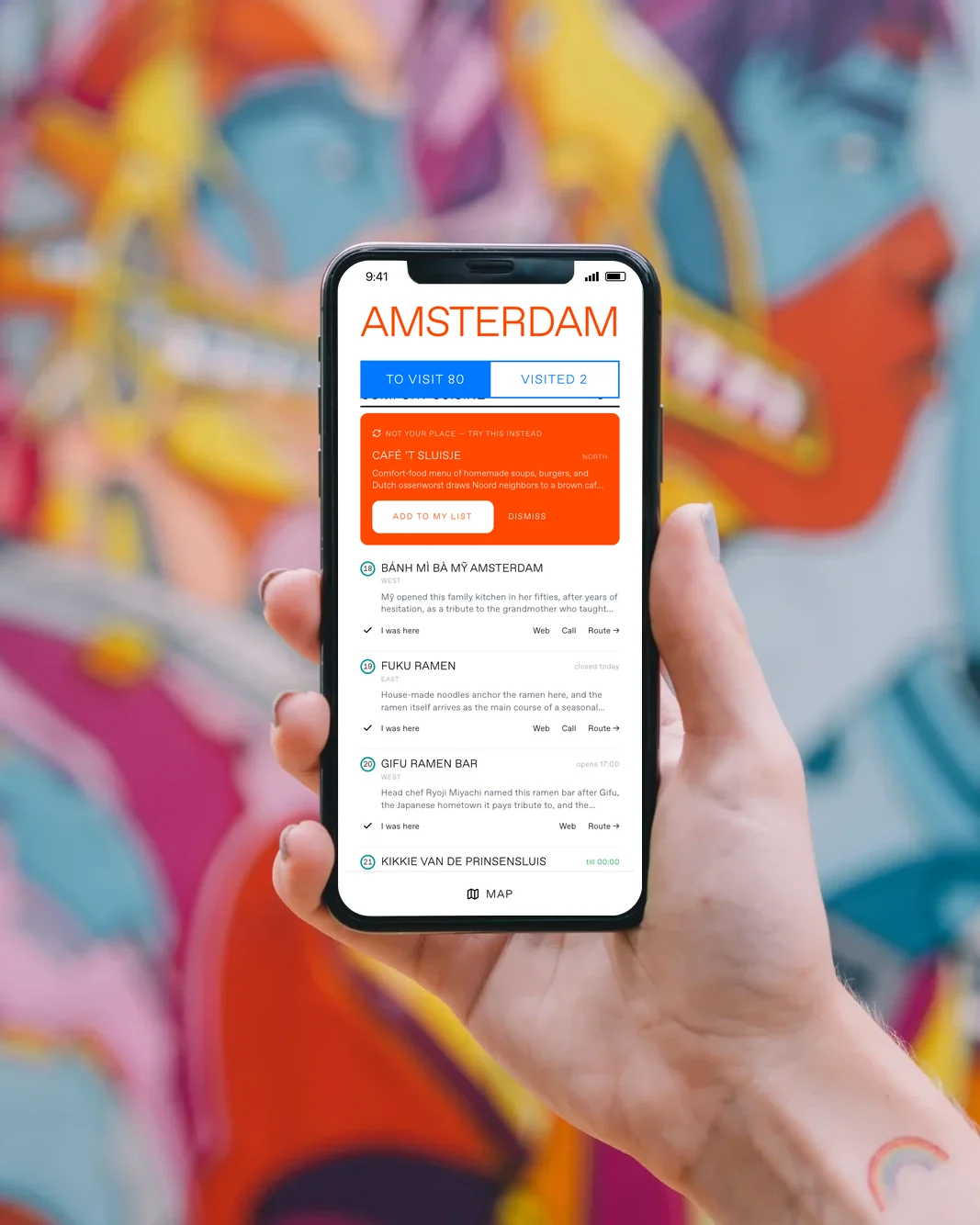
The traveller buys the guide once and keeps it. It stays current: if a place closes, even a year later, the guide marks it. Travellers can add their own finds at any time, from Instagram or a friend’s tip, right next to ours. After each visit, they can leave themselves a note on what they liked, what they didn’t and why, so the next trip starts where the last one ended.
Sized to the trip
The guide is built around three things: what the traveller is into, how many days they have and which part of the city they are staying in. It holds only as many places as they can realistically visit, in and around the area they chose.
Never out of date
A guide on paper ages the day it is printed. This one keeps changing during the trip: a place the traveller did not like gets a replacement, and a place that closes is flagged before anyone crosses the city to a locked door.
Picked by locals
The base is put together by people who live in the city, so it holds the places that are good right now. When a place loses its edge or stops being worth the trip, it stops appearing in new guides.
One purchase, not a subscription
People travel a few times a year, so a subscription makes little sense. The traveller pays once for a guide scoped to their trip: the shorter and narrower the trip, the lower the price.
Kept current on autopilot
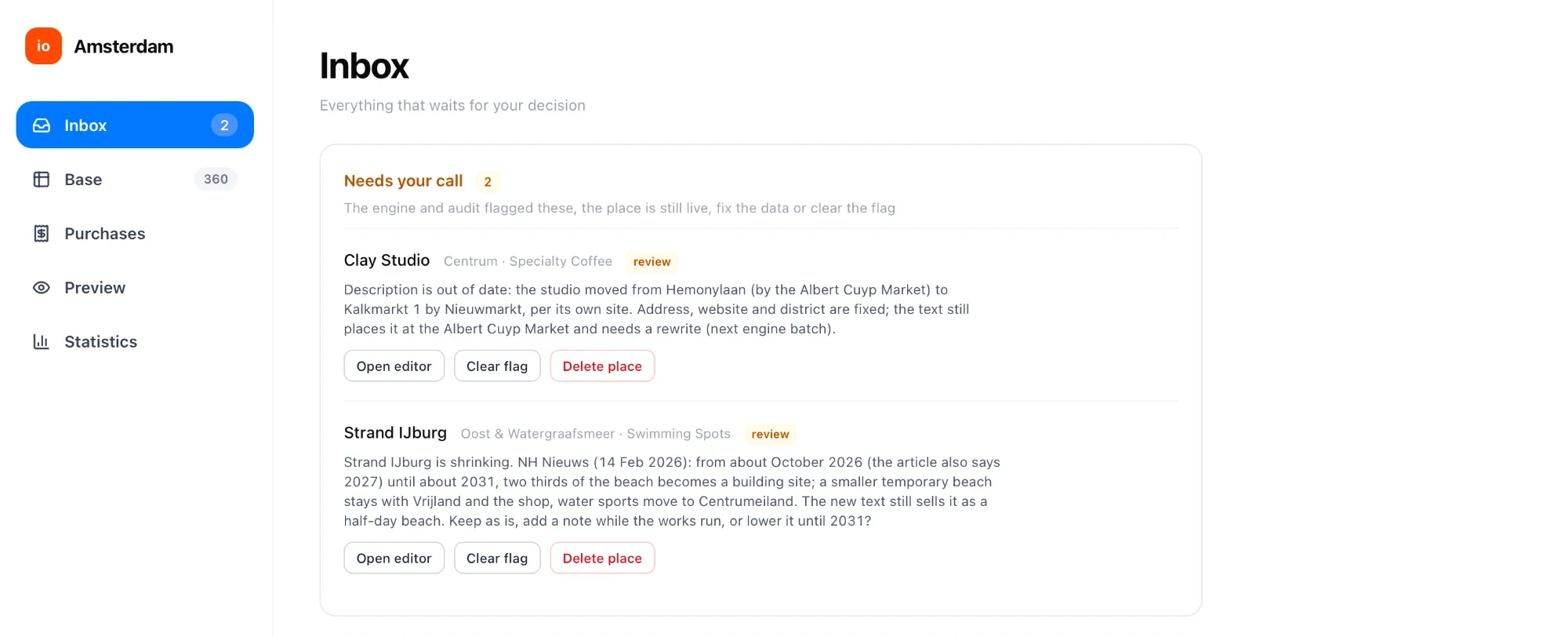
A daily check runs through all 300+ places, and an AI pipeline flags descriptions that have gone stale. Everything that needs a human call lands in one inbox, so keeping the base current takes me minutes, not days.
How AI does the work
AI is not a feature of InsideOut. It is how one person runs it.
- An LLM pipeline researches, writes and verifies every place description, all in one editorial voice.
- Around it sit the checks that keep it honest: structured outputs, a rules linter, a fact-checking pass and an independent audit.
- The web app, the admin panel, the bot and every deploy are built and run with AI coding agents.
Takeouts
Building InsideOut alone taught me that AI does not replace a team; it changes what one person can carry. The work did not get smaller. It moved from writing code to deciding what to build, checking what was built and saying no to what was not good enough.
I also learned that a language model is a brilliant writer and an unreliable witness. It can describe a place beautifully and still get the address wrong. Every text it wrote had to pass a check, and the checks took as much thought as the prompts.
And I came to see that AI makes generic travel advice free. Anyone can ask a chatbot for the best cafés in Amsterdam. What it cannot give is taste: someone who lives in the city and decides what is worth your few days. That is what travellers are still willing to pay for.