Building a free task tracker that brought small businesses into the MTS ecosystem
My role
As the Head of the SMBs Department, I set the strategy for MTS Your Business and the role WorkZen played in it: the free core that brought owners into the ecosystem. The product itself was run by a product owner in my team, Rita Konstantinova.
My team
Up to 19 people on WorkZen.
The problem
Small businesses ran their work in chats, Google Docs and simple tools like Trello. These were made for everyone, not for owners, and did not cover what a small business needs. Tools built for business, such as the sales CRM amoCRM, went the other way: too heavy and too narrow, because they focused only on sales.
We saw a gap. Nothing on the market worked as simply as Trello and was made for entrepreneurs, and such a product could spread fast and cheaply among the owners MTS wanted to reach. Our challenge was to build one tool that would fit any small business, from a flower shop round the corner to a seller on an online marketplace.
The idea
Trello for entrepreneurs, with a little of a CRM: free, with no limits on people, projects or tasks. An owner connects it to handle requests from customers, no matter where they come from, online or offline. Then the owner brings in the team that works with them.
WorkZen would be the free core of the portfolio: the product that brings users in, while the other MTS services earn the money.

Product design by Pavel Putrenok and Ilya Kovalev, MTS Design. Full design case on Behance ↗
What we built
We launched the web version in February 2020 and added mobile apps a few months later. Step by step, WorkZen covered the basic needs of a small team: who does what, by when, and what the business gets out of it. Acquisition settled into a steady flow at a cost below our target, and by the end of the first year WorkZen had 26K monthly active users.
- 94K
- registered users
by February 2021 - 26K
- monthly active users
by February 2021 - ~€6
- average cost
to acquire a user
What is next?
Usage data showed that teams lived in their tasks and rarely opened the client features. So we doubled down on the task tracker and let the CRM part step back. We added observers to keep the whole team in the loop, roles and access rights for teams that grew, time tracking to see where the hours went and Gantt charts for longer projects.
Simple by default
Projects, tasks and subtasks, observers, recurring tasks and templates. A new team could start working in minutes, without a setup guide.
Work where the team already is
Tasks could arrive by email or through a Telegram bot, which 1,585 users connected in its first 14 days. Calendars, website forms and other MTS services fed requests straight into the board.
Accessible to everyone
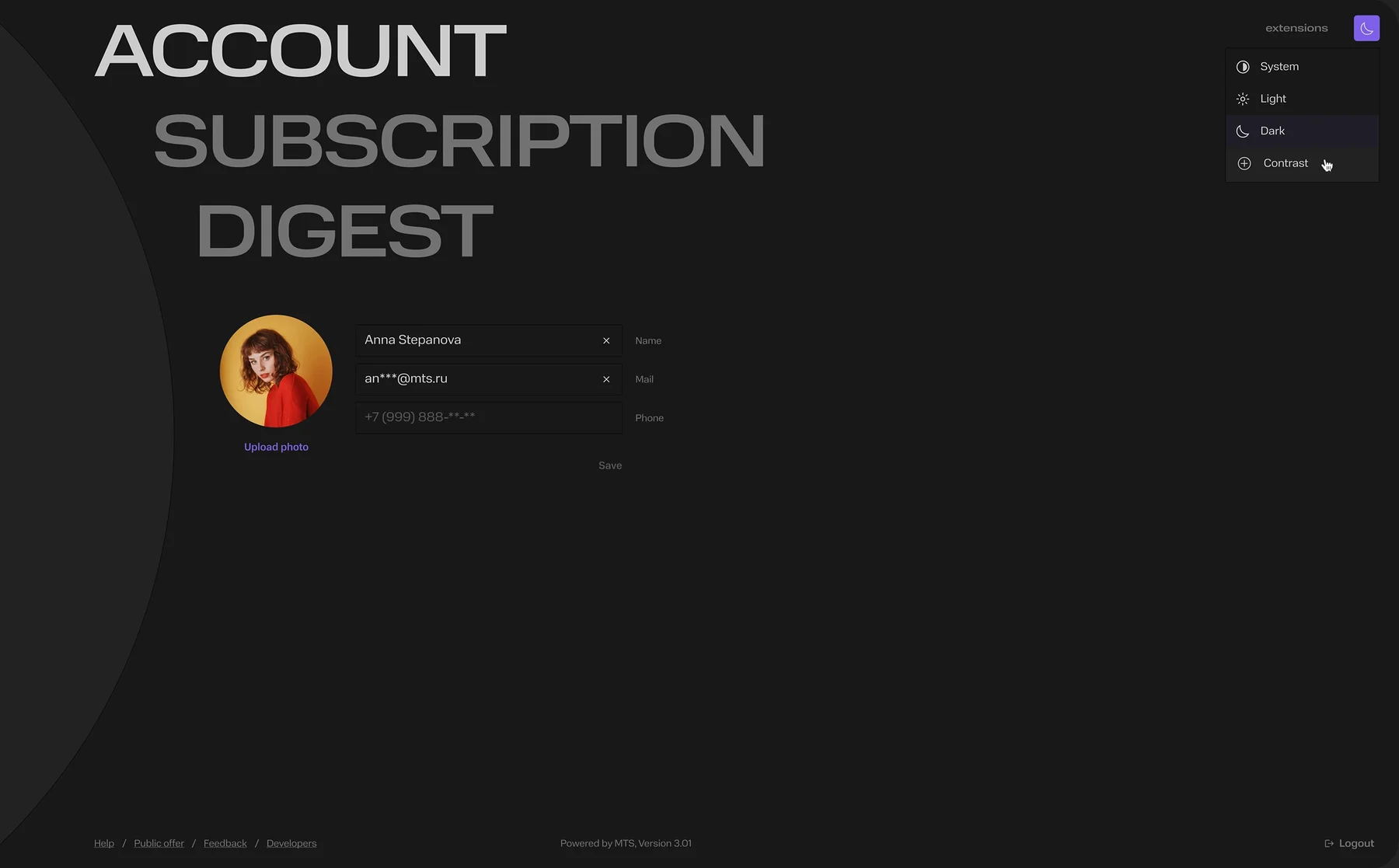
WorkZen was the first MTS product to fully meet the AA level of digital accessibility. It works with screen readers and the keyboard, in light, dark and high-contrast themes.
How it grew
Then we took WorkZen in two directions. Up, to companies of 50+ people, with corporate access and tasks that assign themselves to the right person. And deeper into MTS, so that a call from a customer would turn into a task with the client and the recording attached.
Results
- 138K
- monthly active users
in December 2021 - 56K
- weekly active users
in December 2021 - 12.8K
- daily active users
in December 2021 - ~40K
- users added another MTS
service by December 2021
Takeouts
Working on WorkZen taught us that free is a strategy, not a gift. A product that owners opened every day became the cheapest way into the whole MTS ecosystem. But free also meant we had to earn their attention again each morning, so retention mattered more to us than any campaign.
We also learned to let users tell us what the product is. We set out to build a light CRM, and the data showed that teams lived in their tasks. The moment we followed their behaviour instead of our plan, and cut the product down to projects, tasks and subtasks, WorkZen started to grow.